
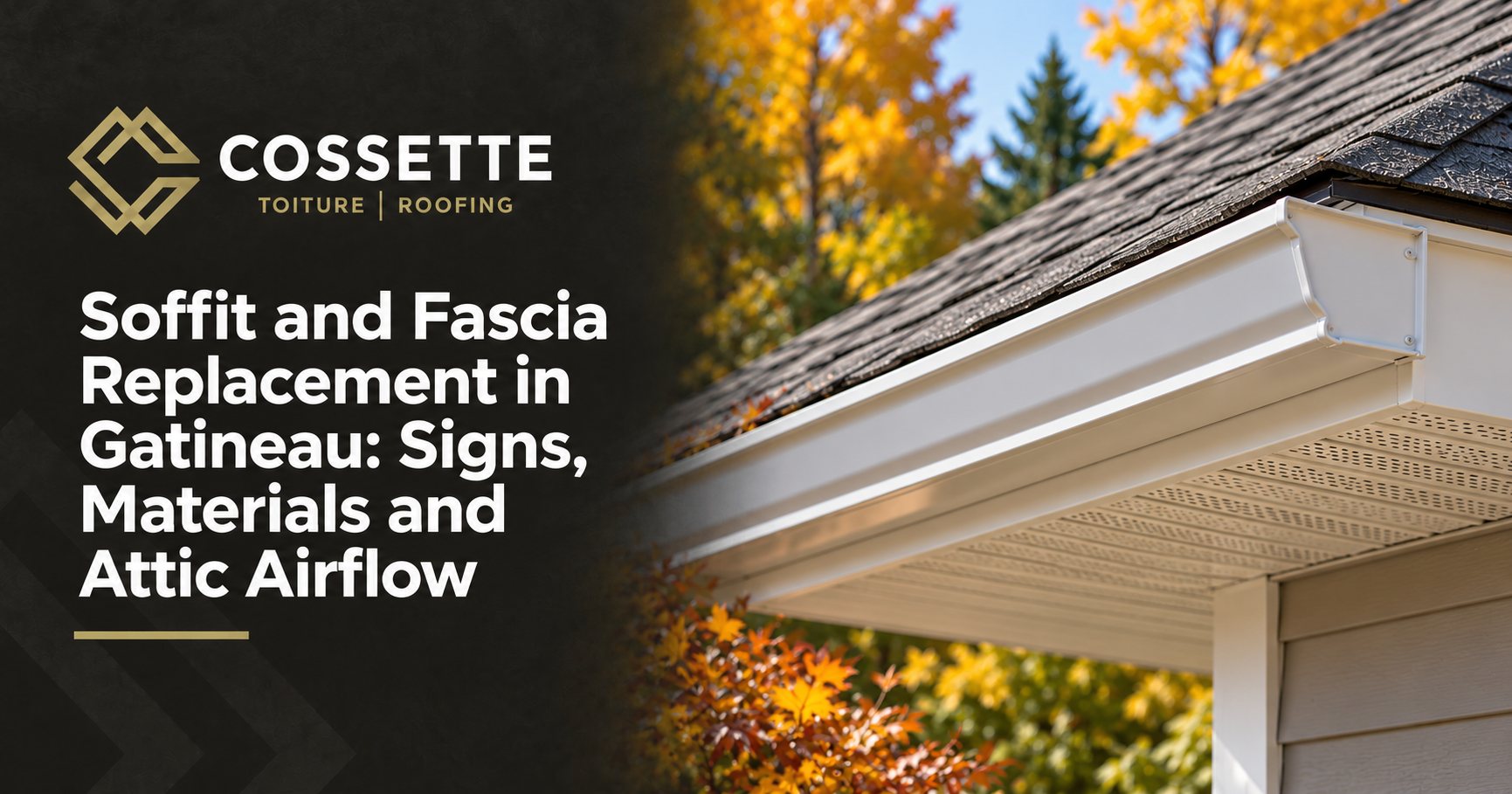
Soffit and fascia replacement in Gatineau is often the repair homeowners notice last, even though the roof edge does some of the hardest work on the house. The fascia carries the gutters and seals the ends of the rafters. The soffit closes off the underside of the overhang and lets outside air into the attic. When either one fails, water, pests and moisture problems follow. Cossette Roofing has served the National Capital Region since 2005, with soffit and fascia work as part of its roofing services. This guide explains the warning signs, the materials that hold up in our climate, and how the work is done.
What the Soffit and Fascia Actually Do
The fascia is the long vertical board that runs along the edge of the roof, just under the shingles. It closes off the rafter ends, gives the roofline a finished look and provides the surface the gutter hangers are screwed into. The soffit is the horizontal panel under the roof overhang. When it is perforated, it acts as the air intake for the attic.
The two parts meet at a corner along the whole roofline. That joint has to be closed properly, or birds, insects and small animals can get into the eaves and attic. Because the two parts depend on each other, they are usually inspected and repaired together.
Why Soffit Airflow Matters for Your Roof
Soffit vents are the starting point of attic ventilation. Outside air enters through the soffits, flows up under the roof deck and leaves through vents near the ridge. This airflow keeps the attic cool and dry, which protects the roof boards and shingles.
In winter, blocked or damaged soffits are a serious problem. CAA-Quebec’s guide to ice damming states that ice formation along roof edges is almost always caused by poor attic ventilation and inadequate soffit ventilation, and that outdoor air must enter the roof through clear, unobstructed soffits. When soffits are painted shut, crushed or blocked by insulation inside the attic, warm, moist air stays trapped. That leads to frost on the roof boards, ice dams at the eaves and, over time, rot. For more on how the whole system works, see our guide on attic ventilation and why it matters in Gatineau.
Signs Your Fascia Needs Repair or Replacement
Fascia damage usually starts with water. When a gutter overflows, leaks or is hung too low, water runs behind the trough and soaks the board. Look for these signs:
- Peeling paint, dark stains or water marks along the fascia.
- Wood that feels soft or crumbles when pressed.
- Gutters that sag or pull away from the roof edge.
- Gaps at the corners where pests could get in.
- Water dripping behind the gutter during rain.
If the rot is limited to a short section, that section can be cut out and replaced. If the board is failing along its length, Cossette’s fascia page notes that patching it buys a season at most.
Signs Your Soffit Needs Attention
Soffit problems are easy to miss because you have to look up to see them. Walk around the house and check for:
- Panels that are sagging, bent, loose or missing.
- Stains or water marks, which often point to a leak at the roof edge or gutter.
- Signs of animals, such as chewed edges, nesting material or droppings.
- Vents that are painted over or clogged with dirt.
Inside the attic, check that insulation is not pushed tight against the soffit area. Even perfect soffit panels cannot ventilate the attic if insulation blocks the air path behind them. Baffles, also called deflectors, are installed between the rafters to hold insulation back and keep a clear channel for air. If you see compressed insulation at the eaves or no baffles at all, mention it during your evaluation so the airflow can be checked along with the trim.
Why Aluminum Cladding Suits the Outaouais Climate
Wood fascia that is left exposed needs regular painting and will eventually rot. Cossette’s approach wraps the fascia board in factory-finished aluminum so water never reaches the wood again. The finish is colour-stable, never needs painting and does not rust in a climate of road salt and freeze-thaw. Damaged wood is cut out and replaced with sound lumber first, and rot is never covered over.
CAA-Quebec notes that soffits are most often made of perforated aluminum, which lets air into the attic while keeping pests out. Choosing the right panel and making sure the attic side stays open is what keeps the airflow working.
What Is Included in a Cossette Fascia and Soffit Job
A roof edge repair is more than new trim. Cossette’s work on the roofline covers:
- Rot removal: damaged wood is cut out and replaced with sound lumber.
- Aluminum cladding: the board is wrapped in factory-finished aluminum, colour-matched to the trim.
- Gutter re-hang: gutters are re-hung on the new fascia with hidden hangers at proper spacing.
- Drip edge check: the metal edge above the fascia is checked so water is directed into the trough, not behind it.
- Soffit junction: the meeting line between fascia and soffit is closed so pests cannot enter at the corner.
You can read more on the Cossette fascia repair and replacement page.
The Process From Evaluation to Cleanup
Every project starts with a free on-site evaluation. The estimator probes the full roofline for soft wood and finds the source of the water, so the repair fixes the cause and not just the damage. You then receive a written estimate covering the lengths to be repaired or replaced and the cladding colour, with no hidden fees. Once the work is done, the crew clears every offcut and fastener from the property before leaving.
Customers notice this care. One customer who had a shed reshingled wrote in a Google review (in French) that the work site was kept clean and organized from start to finish, and that a crew member, Kim, took the time to answer all of their questions.
Fall is a good time to deal with the roof edge. Soft fascia and blocked soffits are much easier to fix before snow, and a sound roof edge helps gutters and attic ventilation do their jobs through the winter.
Why Homeowners Choose Cossette for Roof Edge Repairs
Cossette Roofing holds RBQ licence 5697-7788-01, carries full liability insurance on all work, and has been BBB-accredited since August 2020. With offices in Gatineau and Ottawa, the company is licensed and insured on both sides of the river. On the Quebec side, Cossette serves Gatineau, Hull, Aylmer and the wider Outaouais. On the Ontario side, it serves Ottawa, Kanata, Orléans, Stittsville, Embrun, Clarence-Rockland and Cornwall.
Frequently Asked Questions
What is the difference between soffit and fascia?
The fascia is the vertical board along the roof edge that holds the gutters. The soffit is the horizontal panel under the roof overhang that closes off the eaves and, when vented, lets outside air into the attic.
Can I replace the fascia without replacing the gutters?
Yes. The gutters are taken down, the damaged fascia is repaired or replaced, and the gutters are re-hung on the new board with hidden hangers. If the gutters are old or leaking, it can make sense to replace them at the same time.
Why is my fascia rotting?
Fascia usually rots because water is getting behind the gutter. A leaking or overflowing gutter, a missing drip edge or a gutter hung at the wrong height can all send water onto the board.
Do vented soffits really help prevent ice dams?
Clear soffit vents let cold outside air flow under the roof, which keeps the roof surface colder and helps reduce ice dams. CAA-Quebec notes that ice along roof edges is almost always caused by poor attic and soffit ventilation.
How much does soffit and fascia replacement cost in Gatineau?
The cost depends on the length of roofline, how much wood has rotted, and whether the gutters need to come down. Cossette provides a free, no-obligation written estimate for every project in Gatineau, Ottawa and the Outaouais.
Summary
The soffit and fascia protect the roof edge and keep the attic breathing. Soft, stained fascia usually means water is getting behind the gutter, and blocked soffits trap moisture that leads to frost and ice dams. The lasting fix replaces rotten wood, wraps the fascia in factory-finished aluminum and keeps the soffit airflow open. Dealing with the roof edge in fall helps gutters and attic ventilation work properly all winter.
Key Takeaways
- The fascia holds the gutters and seals the rafter ends, and the soffit lets outside air into the attic.
- Blocked or damaged soffits trap moisture and are a leading cause of ice dams.
- Soft, stained or peeling fascia usually means water is getting behind the gutter.
- Rotten wood is replaced first, then wrapped in factory-finished aluminum that never needs painting.
- Every job starts with a free evaluation that finds the source of the water.
Need help with your roof? Call Cossette Roofing at 819-777-7177 or request your free estimate.