
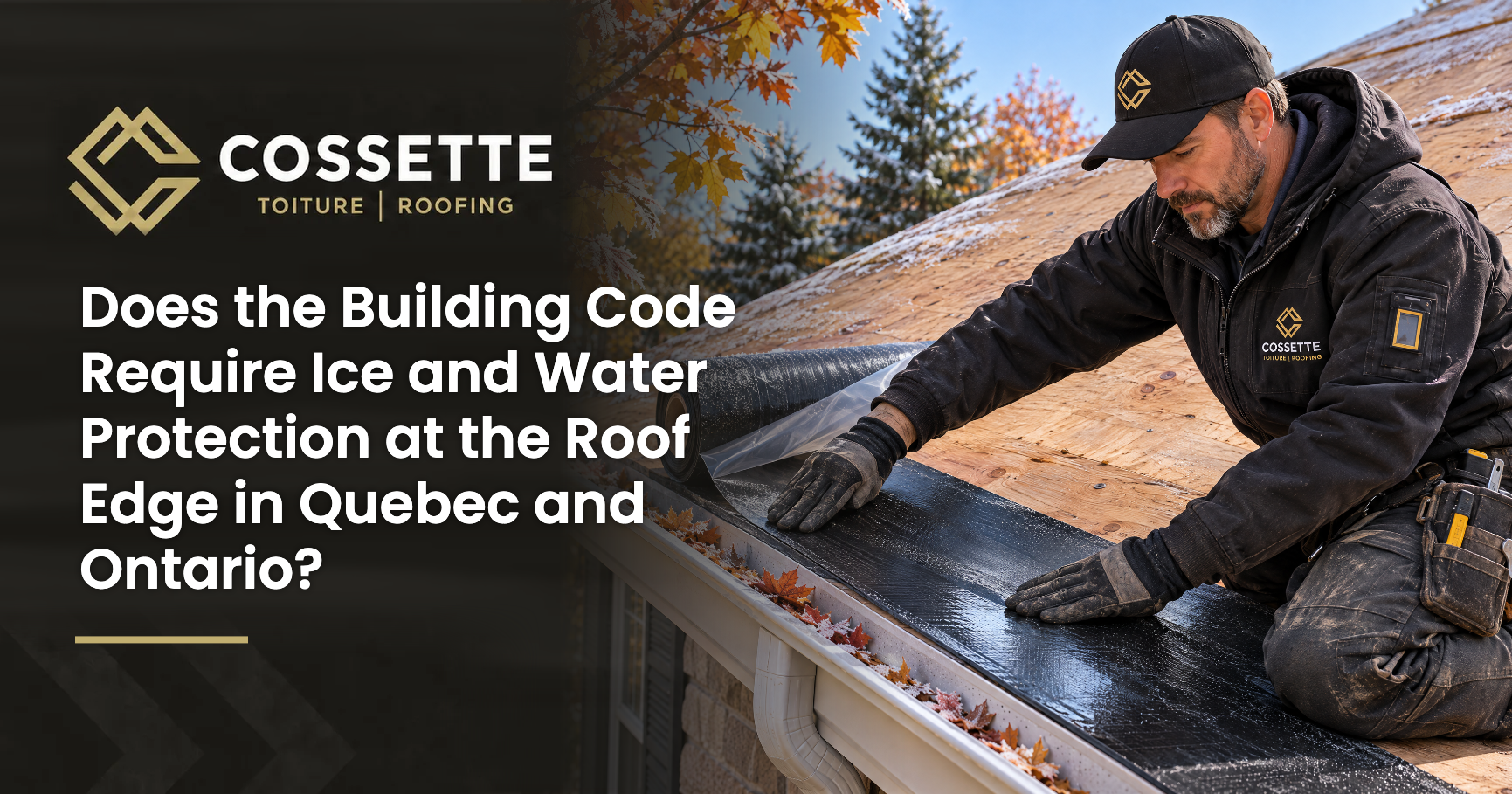
| Quick Answer: Yes. Building codes in Canada require eave protection on most shingle roofs in cold regions, including Gatineau and Ottawa. The membrane must run from the roof edge at least 900 mm up the slope, to a line at least 300 mm inside the inner face of the exterior wall. It limits leaks from ice dams. Cossette Roofing repairs ice dam damage and replaces shingle roofs across the region. Call 819-777-7177. |
Every winter, homeowners in Gatineau and Ottawa find water stains on ceilings near outside walls and wonder how water got under shingles that look fine. In many cases the answer is an ice dam, and the layer that is supposed to stop that water is the eave protection under the shingles. This guide explains what the building code asks for, where the exceptions are, and what it means when you replace a roof.
What Is Eave Protection on a Roof?
Eave protection is a waterproof membrane installed on the roof deck along the lower edge of the roof, under the shingles. Most people know it as ice and water shield. It is usually a self-adhering membrane that seals around the nails driven through it.
Shingles are designed to shed water that runs downhill. They are not designed to hold back water that is standing still or moving uphill. Eave protection covers that weakness at the place where standing water is most likely, which is the cold edge of the roof above the eaves.
Does the Building Code Require Eave Protection in Gatineau and Ottawa?
Yes. The model National Building Code of Canada, which provincial codes in Quebec and Ontario are based on, requires eave protection on shingle, shake and tile roofs in cold regions. Gatineau and Ottawa both fall well within the climate range where the rule applies.
The requirement sits in the part of the code that covers houses and small buildings. Provinces adopt the national model with their own amendments and on their own schedules, so the edition in force can differ between Quebec and Ontario. The basic rule on eave protection has been consistent across editions. Your roofer should work to the edition that applies to your property on the date of the work.
How Far Up the Roof Must Eave Protection Extend?
Eave protection must extend from the edge of the roof at least 900 mm up the roof slope, to a line at least 300 mm inside the inner face of the exterior wall. Both conditions apply, so on a home with wide overhangs the membrane has to go higher than 900 mm to reach that line.
In plain terms:
- 900 mm is about three feet, measured along the slope from the roof edge.
- 300 mm is about one foot, measured past the inside face of the outside wall.
- The point is to cover the cold overhang and the first stretch of roof above the heated space.
These are minimums. On low slopes, in valleys and around chimneys and skylights, many roofers install more membrane than the code asks for, because those are the places where water is slow to drain.
Why Does Eave Protection Matter for Ice Dams?
Eave protection matters because it is the last barrier when an ice dam forces water under the shingles. An ice dam forms when heat escaping through the roof melts snow higher up. The meltwater runs down to the cold eaves and refreezes. A ridge of ice builds up, and the water behind it has nowhere to go but under the shingles.
A membrane that is sealed to the deck keeps that water out of the house while it sits there. It does not stop the ice dam from forming. That part depends on attic insulation and ventilation, which keep the roof deck cold so the snow melts evenly. Our guide to ice dams in Gatineau covers the causes and the repairs, and our article on attic ventilation explains why airflow matters.
Are There Exceptions to the Eave Protection Rule?
Yes. The code lists a small number of cases where eave protection is not required. They include:
- Roofs over unheated garages, carports and porches, where there is no heat to melt the snow.
- Roofs where the overhang is wider than 900 mm measured along the slope.
- Steep roofs with a slope of 1 in 1.5 or greater.
- Regions with 3,500 or fewer heating degree-days, which does not include Gatineau or Ottawa.
There is also an exception tied to a specific low-slope shingle application method described in the code. The list varies slightly by edition and by province, so treat it as a guide and not a legal reference. For most heated homes in this region, eave protection is required and is good practice even where an exception might apply.
Does an Older Roof Have Eave Protection?
Not always. Many older roofs were built with little or no eave protection, or with materials that have broken down over time. You cannot tell from the ground, because the membrane is hidden under the shingles.
A roof replacement is the moment to correct this. When the old shingles are removed down to the deck, the roofer can inspect the wood, replace damaged boards and install new eave protection before the new shingles go on. If your home has a history of winter leaks near the outside walls, tell your roofer during the estimate so the quote reflects it.
What Should You Ask Your Roofer About Eave Protection?
Ask how much membrane will be installed and where, and get the answer in the written quote. These questions cover the essentials:
- How far up the roof will the eave protection extend?
- Will membrane also be installed in valleys and around chimneys, vents and skylights?
- Will the old roof be removed to the deck so the wood can be inspected?
- Will you check the attic insulation and ventilation?
- Is the eave protection listed as a line in the quote?
Cossette Roofing has replaced and repaired roofs in Gatineau, Ottawa and the Outaouais since 2005. The company’s residential services include attic inspection and ventilation correction, and its emergency response to ice dams includes controlled ice removal, temporary waterproofing and a repair plan. Every roofer on the team completes annual training on building code requirements in both Quebec and Ontario.
Frequently Asked Questions
Is ice and water shield required by code in Quebec?
Eave protection is required on most shingle roofs in cold regions under the national model code that Quebec’s code is based on. Gatineau is well within the climate range where the rule applies. Your roofer should follow the edition in force for your property.
How far should ice and water shield go up the roof?
At least 900 mm up the slope from the roof edge, and to a line at least 300 mm inside the inner face of the exterior wall. On homes with wide overhangs, that means going higher than 900 mm.
Does eave protection stop ice dams?
No. It limits leaks when an ice dam forms. Preventing ice dams depends on attic insulation and ventilation that keep the roof deck cold.
Can eave protection be added without replacing the roof?
Not properly. The membrane sits on the deck under the shingles, so it is installed when the shingles are removed. A roof replacement is the right time to add or upgrade it.
Who repairs ice dam damage in Gatineau and Ottawa?
Cossette Roofing offers 24/7 emergency service for ice dams and water infiltration across Gatineau, Ottawa and the Outaouais. Call 819-777-7177 at any time.
Summary
Building codes require eave protection on most shingle roofs in Gatineau and Ottawa. The membrane runs at least 900 mm up the slope and past the exterior wall line, and it limits leaks when ice dams form. A roof replacement is the right time to confirm it is installed correctly.
Key Takeaways
- Building codes require eave protection on most shingle roofs in Gatineau and Ottawa.
- The membrane must reach at least 900 mm up the slope and 300 mm inside the exterior wall line.
- Eave protection limits ice dam leaks. Insulation and ventilation prevent the ice dam.
- Exceptions exist for unheated garages, wide overhangs and steep roofs.
- Older roofs may have little or no eave protection. A replacement is the time to fix it.
- Ask for the eave protection to be written into your quote. Call 819-777-7177.
Need help with your roof? Call 819-777-7177 or request your free estimate.